
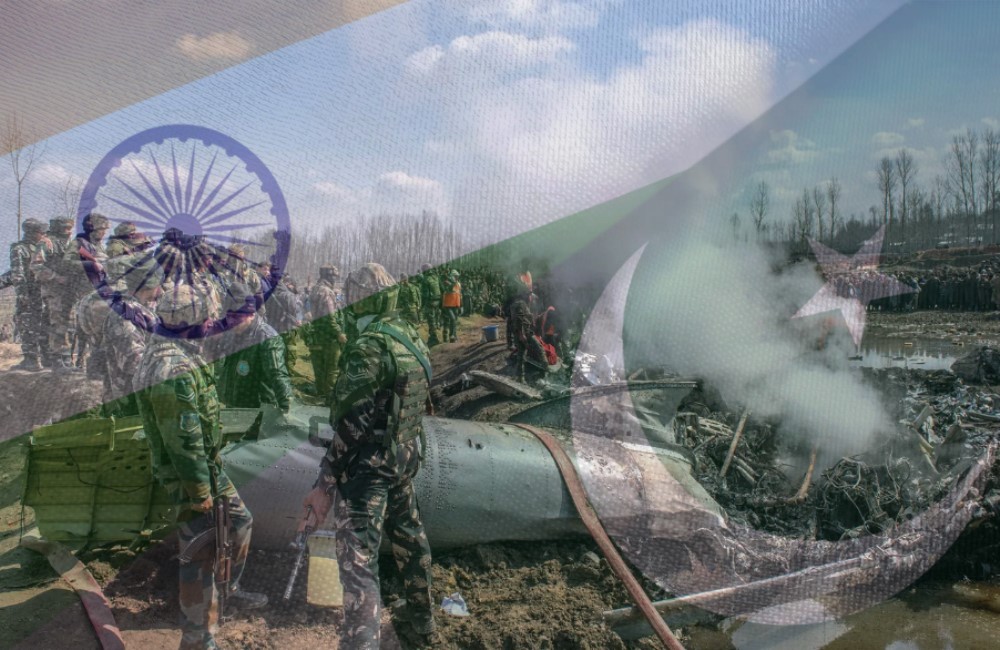
The New York Times criticized Indian media’s role in spreading disinformation and blatant lies during the recent Indian-Pakistan conflict.
Review-Article
In the wake of the latest flare-up between India and Pakistan, The New York Times (NYT) article “How the Indian Media Amplified Falsehoods in the Drumbeat of War” offers a sobering diagnosis of the disinformation crisis infecting India’s mainstream media.
This isn’t simply a story of social media running amok with fake news or bots pushing fabricated narratives; it is a case of major television networks and reputed journalists abandoning basic journalistic rigour in favour of jingoistic spectacle.
As reported by New Delhi based Anupreeta Das and Pragati K.B., with contributions from Salman Masood, the article outlines a clear trajectory: during the brief but intense military standoff, claims about strikes on Pakistani nuclear installations, downed jets and attacks on Karachi port flooded both social and mainstream media. Not only were these reports unverified, but they were demonstrably false; fabricated stories that would later be discredited through diligent fact-checking and official clarification.
And yet, they were broadcast with full confidence and patriotic fervour, complete with visuals, graphics and strategic maps that never corresponded to actual events.
At the core of this issue is a troubling trend that scholars and observers have warned about for years: the growing politicization and ideological capture of Indian news media, particularly television. The erosion of editorial independence in the Modi era, as the article points out, has left many outlets vulnerable to state influence or complicit in serving its narratives. The result is a media environment where disinformation doesn’t just spread from the shadows, it is propelled by marquee names and prime-time broadcasters.
This isn’t just a lapse in judgment or the heat of breaking news. It reflects a structural failure in India’s media landscape, where ratings, proximity to power and hyper-nationalistic rhetoric often override the foundational principles of accountability and verification.
Rajdeep Sardesai’s on-air apology, as highlighted in the NYT report, signals a rare act of introspection, but it also underscores the scale of misinformation that had already permeated public discourse by the time journalists began walking back their claims.
The real danger, as experts like Sumitra Badrinathan and Daniel Silverman argue in the piece, is not simply that misinformation exists; it always has, but that formerly reliable sources have themselves become vectors of disinformation.
This is compounded by the psychological terrain: in India and Pakistan, where nationalist sentiment runs high and historic animosities shape public perception, emotionally charged falsehoods find an all-too-receptive audience. When these narratives are reinforced by trusted media, the line between journalism and propaganda disintegrates.
Efforts by independent outfits like Alt News, led by Pratik Sinha, show that fact-checking still holds a line; albeit a fragile one. That such organizations face defamation suits and harassment for doing basic journalistic work is both revealing and disturbing.
Meanwhile, with over 200 million TV-owning households and hundreds of news channels competing for eyeballs, the scale of potential misinformation is staggering. A single viral falsehood can embed itself in the national imagination in minutes and correcting it, if it’s even possible, can take weeks or longer.
Related Posts
And while Pakistan’s own media ecosystem is not without its flaws, the spotlight here is rightly on India, whose press once prided itself on its autonomy and vigilance.
The New York Times’ reporting, while sober and grounded, is a stark indictment of how quickly truth can become collateral damage in the theatre of nationalism. Das, Pragati and Masood do not sensationalize, they merely document. But the picture they paint is devastating for the credibility of Indian media.
Ultimately, the NYT article is not just a reflection on a week of conflict, it is a case study in how democratic institutions, when eroded by political pressure and public spectacle, can themselves become instruments of distortion.
And in the dangerous game of war narratives between nuclear-armed neighbors, the cost of such distortion could one day prove far more than reputational.
 OPED COLUMN