
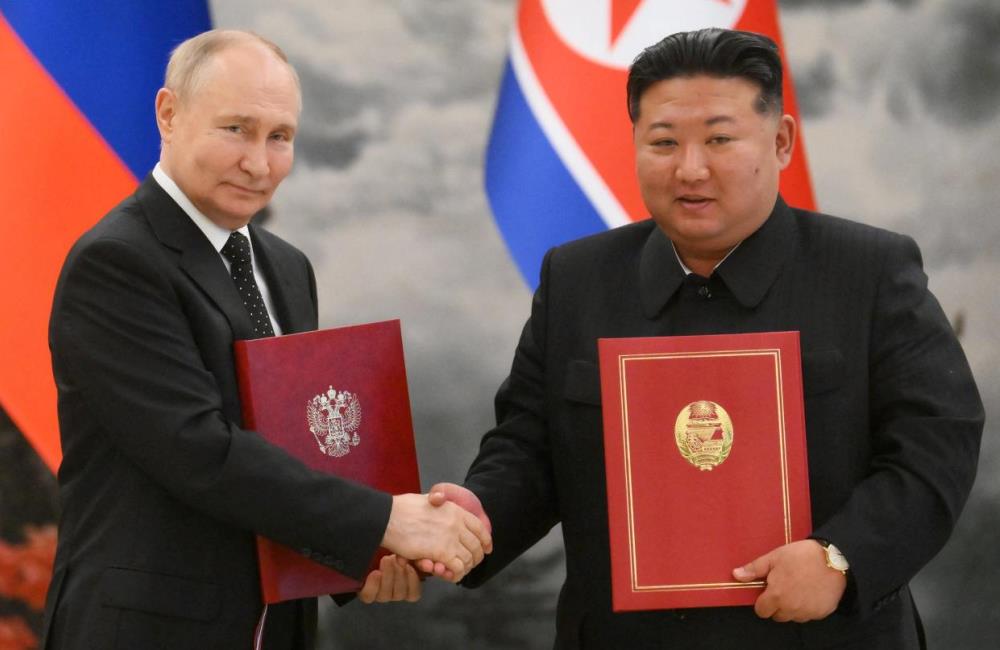
The ‘Axis of Evil’ coined by George W. Bush is not so much redundant for Washington today as in need of descriptive expansion. The threat of a new, enlarged axis of evil is all the greater for the United States’ increasing neo-isolationism.
| Albrecht Rothacher | The Loop |
Russia and China join Iran and North Korea
Twenty years ago, George Bush junior coined the phrase ‘Axis of Evil‘, to characterise the threat posed by Iran, Iraq and North Korea – who, it’s worth noting, were no friends to each other at the time.
Bush waged war on Iraq, he had Saddam Hussein executed and he thoroughly destabilised the Middle East. Yet despite his success in removing Iraq as a serious threat, the regimes in Iran and North Korea remained intact.
Today, Washington would be more than justified in viewing Russia, and even China, as also being part of a new axis.
Related Posts
The Russia-North Korea nexus
After all, despite a continuous three-shift production, the Russian armaments industry is failing to keep pace with the rate of use (and wastage) of ammunition in Ukraine. North Korea, meanwhile, is supplying the Russian army from its seventy-year ammunition stockpile.
Russia’s armaments industry, unable to keep pace with wartime demands, is having to rely on North Korean weaponry
This stockpile even includes missiles with a range of 400–700km, previously used only for exhibition shooting and military parades. Some sceptics had assumed these missiles were dummies. Now, like Western weapons, they are being tested in Ukraine on living objects under real combat conditions.
In breach of UN sanctions, the Kremlin is paying for North Korea’s missile and nuclear armaments with oil and technological aid. The same goes to Iran for its deliveries of combat drones.
These alliances of convenience fit into Vladimir Putin’s concept of distracting and weakening the West through secondary wars against what we might describe as the Iranian-supported activities of Hamas, Hezbollah and the Houthis.
If Kim Jong Un genuinely intended to attack the South any time soon, he wouldn’t be selling off his weapons to the Russians
Whenever Kim Jong Un starts to feel ignored, he attracts attention with skirmishes on the disputed maritime border with the South, and launches nuclear or missile tests. This time he has torn down a pompous reunification monument in Pyongyang, and designated South Korea the new main political enemy. But we cannot take Kim’s threats of war too seriously. If he genuinely wanted to attack the South, he wouldn’t be selling off his ammunition to the Kremlin. Indeed, Putin is expected to make a return visit to Pyongyang in the near future.
The role of China
China’s role in this group is controversial. Beijing enjoys playing the overwhelming protective power of the three sanctioned, so-called pariah countries. Yet this is gradually turning these countries effectively into Chinese raw material colonies, well supplied with military technology, but not with weapons.
China enjoys playing the overwhelming protective power of the sanctioned ‘pariah’ countries
In contrast with its three partners, China has no interest in a destabilisation of Northeast Asia or the Middle East. Indeed, this would endanger its foreign investments and its world trade. This is because China’s economy is barely growing, exacerbated by a housing crisis, high youth unemployment, and an ageing population. In any case, Xi Jinping is busy following his aggressive imperial strategy towards Taiwan and in the South China Sea. He doesn’t want to become once again entangled in foreign wars, as China was in Korea in 1950.
Strengthened military capacities
The four countries’ association into a new ‘axis of evil’ means strengthened military capacities for all involved. This is especially so since Russia, North Korea and Iran already run war economies, even given their lack of export successes, failures in battle, exploding tank convoys, and the semi-sunken Black Sea fleet.
The U.S. and neo-isolationism
The West, on the other hand, is rapidly losing influence worldwide. A new ‘axis of evil’ thus constitutes a serious long-term challenge that could overwhelm even the United States, which is threatened by a neo-isolationist leadership crisis, and an ever-growing silence on the world stage.
Albrecht Rothacher is an independent researcher. Albrecht gained his MA in sociology from the University of Bridgeport in 1978, and a PhD in international relations from LSE in 1982. A stint at Deutsche Bank in the EU’s diplomatic service followed from 1984–2020, with postings in Vienna, Singapore, Paris and Tokyo, lastly as Minister Councillor, mostly dealing with economic and trade issues. He then worked in Brussels as a policy officer, mostly concerned with economic relations with countries ‘East of Berlin and Vienna’; lastly with Russia mainly. He has published 24 books mostly on Asian affairs, economic and military history, but most recently a biography on the French presidents of the 5th Republic. Current research work includes a collective biography of the Austrian chancellors of the 2nd Republic, and French colonial wars 1945–1962 (Indochina and Algeria).
 OPED COLUMN