
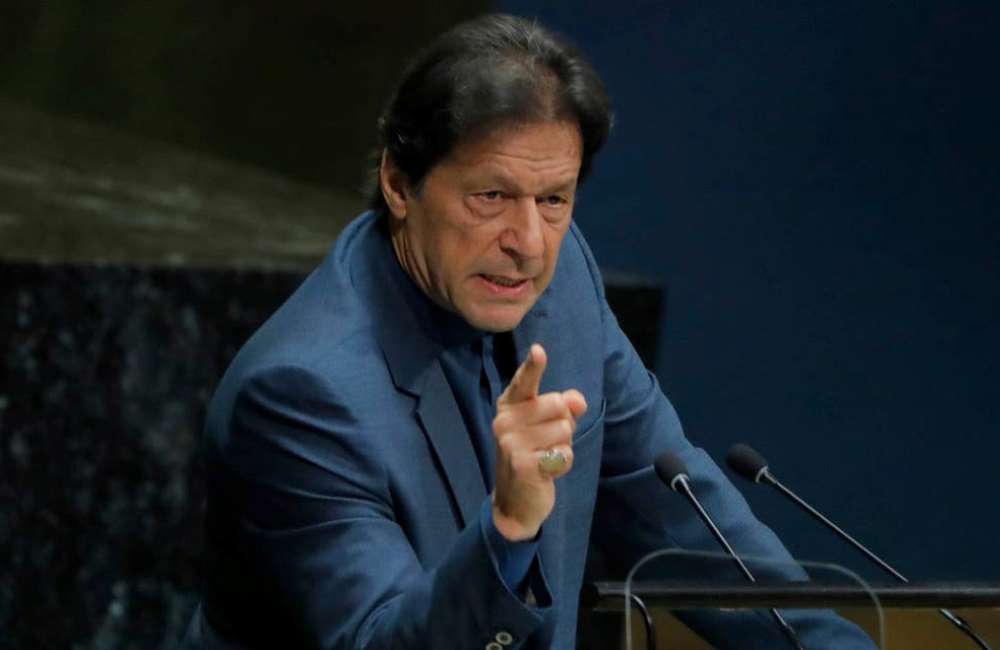
It is crucial for anyone seeking to grasp the broader implications of Khan’s removal and the future trajectory of Pakistani politics to first find out whether foreign interference played a role in Imran Khan’s ouster.
Bahauddin Foizee | Oped Column Syndication
The recent ouster of Imran Khan, the former Prime Minister and leader of the Pakistan Tehreek-e-Insaf (PTI) party, marks a significant and potentially transformative moment in the nation’s history. Khan’s ouster has ignited a storm of controversy and speculation, particularly regarding the role of foreign interference. As Pakistan’s political landscape continues to unravel, the implications of international influence on Khan’s removal are becoming increasingly apparent.
Imran Khan’s ascent to power was nothing short of meteoric. His journey from a cricketing legend to a political leader was driven by a promise of change and a commitment to fight corruption. His election in 2018 was seen as a hopeful signal of reform in a country long plagued by political instability and economic issues.
However, the reality of governance proved to be a harsh challenge. Khan’s tenure was marked by a series of controversies, including allegations of mismanagement, economic difficulties, strained relations with key institutions including the judiciary and the military, and mishandling of relations with major international players.
Related Posts
The culmination of these challenges came in April 2022, when Khan was ousted through a no-confidence vote in Pakistan’s National Assembly, a move that many observers believe was influenced by more than just domestic political dynamics.
The reasons behind Khan’s removal are multifaceted. His critics argue that his government failed to address pressing economic issues, including inflation and debt. The inability to stabilize the economy and manage foreign relations led to growing discontent among the populace and dissatisfaction among powerful factions within the country. Furthermore, the political atmosphere was charged with accusations of mishandling national resources and failing to deliver on his promises of transparency and reform.
On the other hand, Khan’s supporters claim that his ouster was orchestrated by a coalition of vested interests, including political rivals, elements within the military establishment and foreign elements. They argue that Khan’s outspoken criticism of the military’s role in politics, his push for judicial independence and his stance against serving foreign interest made him a target of a broader national and international political conspiracy. This perspective suggests that his removal was less about governance failures and more about a strategic maneuver to maintain the status quo.
While there is no concrete evidence to support every claim, several factors suggest that international actors played a role in his downfall.
Imran Khan’s relationship with the United States was notably strained. His foreign policy emphasized a pivot towards China and criticized US interventionist policies. This approach was at odds with Washington’s strategic interests in South Asia, particularly its desire to counterbalance China’s growing influence in the region. Khan’s adversarial stance might have prompted US officials to support political forces within Pakistan that opposed his leadership.
Furthermore, Pakistan’s strategic importance in the region, especially its role in the Afghanistan conflict and its ties with China, make it a key player in geopolitical rivalries. Khan’s assertive foreign policy, which included criticisms of India’s actions in Kashmir and a push for closer ties with Russia, may have alarmed neighboring countries and their allies. This geopolitical pressure could have contributed to efforts to destabilize his government.
The economic instability during Khan’s tenure might indeed have encouraged foreign interference, as economic instability often makes a country vulnerable to external influence. Khan’s administration faced severe economic challenges, including a debt crisis and declining foreign investment. It’s plausible that foreign actors, particularly those with vested interests in Pakistan’s economic policies, might have used financial and economic pressure as a tool to shape the political outcome.
While foreign interference is a significant factor, it’s crucial to acknowledge the domestic dimensions of Khan’s ouster. His tenure was marked by economic difficulties, governance challenges, and controversies over his handling of key issues. These domestic factors created a volatile environment in which foreign interests could exploit existing fractures.
Political opposition within Pakistan, coupled with economic strains and foreign pressures, provided fertile ground for a no-confidence motion. The convergence of domestic dissatisfaction and external pressures created a scenario where Khan’s political survival was increasingly precarious.
It is worth noting that the political landscape of Pakistan has always been turbulent one, shaped by a complex interplay of power struggles, institutional challenges, and socio-economic factors.
The fallout from Khan’s ouster underscores the complex interplay between domestic politics and international influence. As Pakistan navigates its current political turmoil, the influence of foreign actors will likely continue to be a topic of intense debate. The question remains whether Pakistan can stabilize its political environment and address the underlying issues that contributed to Khan’s removal.
In conclusion, while the exact extent of foreign interference in Imran Khan’s ouster remains debated, it is evident that international dynamics played a role in shaping the political landscape of Pakistan. Understanding this context is crucial for anyone seeking to grasp the broader implications of Khan’s removal and the future trajectory of Pakistani politics.
Bahauddin Foizee is an analyst & columnist focusing on the assessment of threat/risk associated with business, economy and investment as well as legal, security, political and geopolitical threat/risk. His articles on these areas as well as on social, environmental, financial and military affairs in the Asia-Pacific/Indo-Pacific and Middle East regions have been widely published.
 OPED COLUMN